 LiveLingo
Quick Answer
- Nothing to install on their side: call their normal number from LiveLingo. They answer a regular call on any mobile or landline, hear your voice, then a Spanish interpreter voice, and their reply comes back to you in English.
- A human interpreter: pay-per-minute services such as LanguageLine ($3.95 per minute) and Day Interpreting (Spanish from $1.25 per minute) put a live interpreter on the line.
- Your phone may already do it: iPhone 15 Pro and later, recent Galaxy phones and Pixel 10 and later can translate calls on the device, with limits on models and languages.
- Google Translate does not translate phone calls. It is built for conversations in person.
1. Is There a Spanish Translator Phone Number I Can Call?
Yes. Over-the-phone interpreting services connect you to a live human interpreter within moments and bill by the minute. Two of them sell to individuals with a credit card and no contract:
- LanguageLine Personal Interpreter: $3.95 per minute for audio interpreting in more than 240 languages, $4.95 per minute for video. You create an account, then dial their number and enter your PIN, or use their app. No monthly minimum.
- Day Interpreting: Spanish audio interpreting at $1.25 per minute, paid from prepaid credits. The first 30 seconds of each call are free, a 2-minute minimum applies once you are connected, and calls nobody answers cost nothing.
A human interpreter is the right choice for legal, medical and other high-stakes conversations, where a qualified professional should carry the meaning. For everyday calls the friction adds up: you set up an account first, you pay for every minute including time on hold, and you have to get the interpreter and the Spanish speaker onto the same call.
If you are helping a Spanish-speaking relative talk to a clinic or hospital in the US, ask the provider for an interpreter first. Under Section 1557 of the Affordable Care Act, health programs that receive federal health funding must offer a qualified interpreter free of charge, by phone included. HHS spelled this out in a December 2024 letter to health care providers.
2. Your Options Compared
| Option | What the Spanish speaker needs | Cost | Limits |
|---|---|---|---|
| Human phone interpreter | Nothing; they join the call | $1.25 to $3.95 per minute (examples above) | Account setup, per-minute billing, you bring all three parties onto one call |
| iPhone Live Translation (Phone app) | Nothing; it runs on your iPhone | Free | iPhone 15 Pro or later with Apple Intelligence; on calls Apple supports Spanish (Spain) only |
| Samsung Live Translate | Nothing; it runs on your Galaxy phone | Free | Select Galaxy phones with One UI 6.1 or later |
| Pixel Voice translate / Live Translate | Nothing; it runs on your Pixel | Free | Pixel 10 and later; the translation plays in a voice that mimics yours |
| Google Translate on speakerphone | Patience | Free | Not built for calls: you hold a second device to the call audio, and both voices get mixed up |
| LiveLingo translated call | Nothing; any mobile or landline | Pro+ $29.99 per month, up to 90 call minutes to US numbers | You speak, pause, then the translation plays; minutes depend on the country you call |
The built-in features are free and private because they run on the phone, but they depend on your phone model and language list. Apple's call translation lists Spanish (Spain) only, according to Apple's feature availability page, which matters if the person you are calling speaks Mexican or US Spanish. If your phone is on the list, try it first. Our guide to which phones can translate calls covers each one.
3. How to Call a Spanish Speaker With LiveLingo
- Install LiveLingo on your iPhone or Android phone, or open the Call tab in the web app on a computer.
- Verify your own phone number once with an SMS code.
- Choose Spanish as the language the other person speaks.
- Enter their mobile or landline number and start the call.
- Speak in English and pause after each sentence. They hear your voice, then the Spanish translation.
- They reply in Spanish. You hear their voice, then the translation into English.
- After you hang up, read the AI memo with the transcript in both languages.
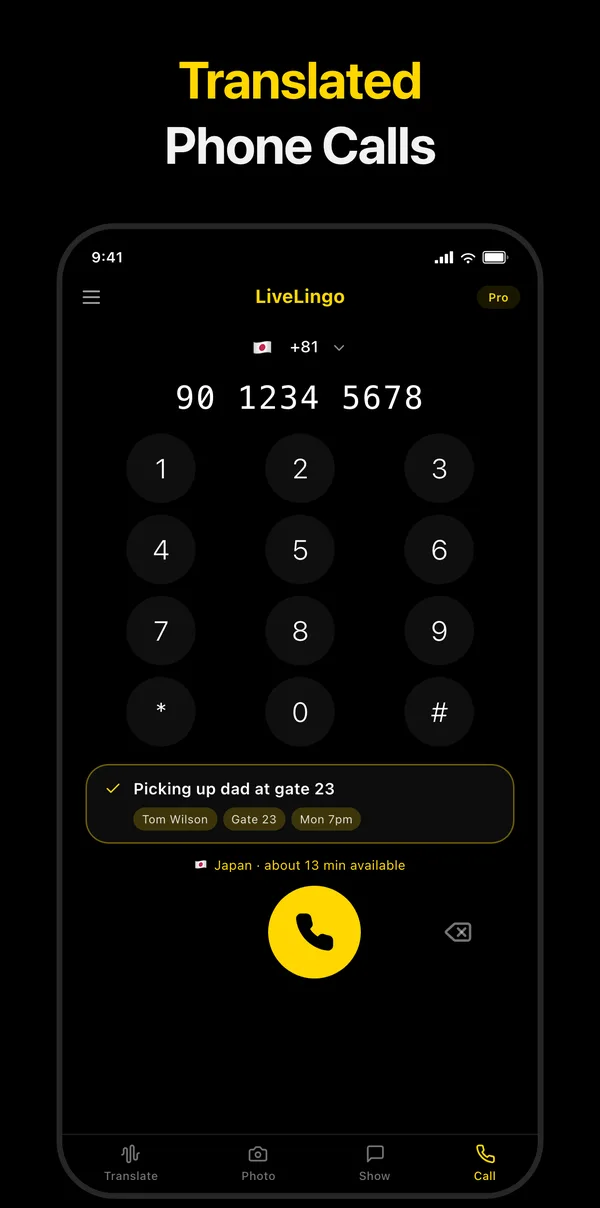
Your side of the call runs over the internet from the app (Wi-Fi or mobile data), and LiveLingo places the regular phone call to the Spanish speaker, so your phone plan isn't charged for an international call.
4. What the Spanish Speaker Hears
- Their phone rings like any normal call. No app, link or account. Landlines work.
- A short greeting in Spanish: "Hola, es una llamada traducida de [your name] a través de LiveLingo. Responda después de cada traducción." It tells them a translated call is starting and asks them to answer after each translation.
- Your real voice while you speak, with your tone intact.
- Then the Spanish translation, spoken by a separate interpreter voice when you pause. LiveLingo never clones your voice, so the other person always knows which part is you and which is the translation.
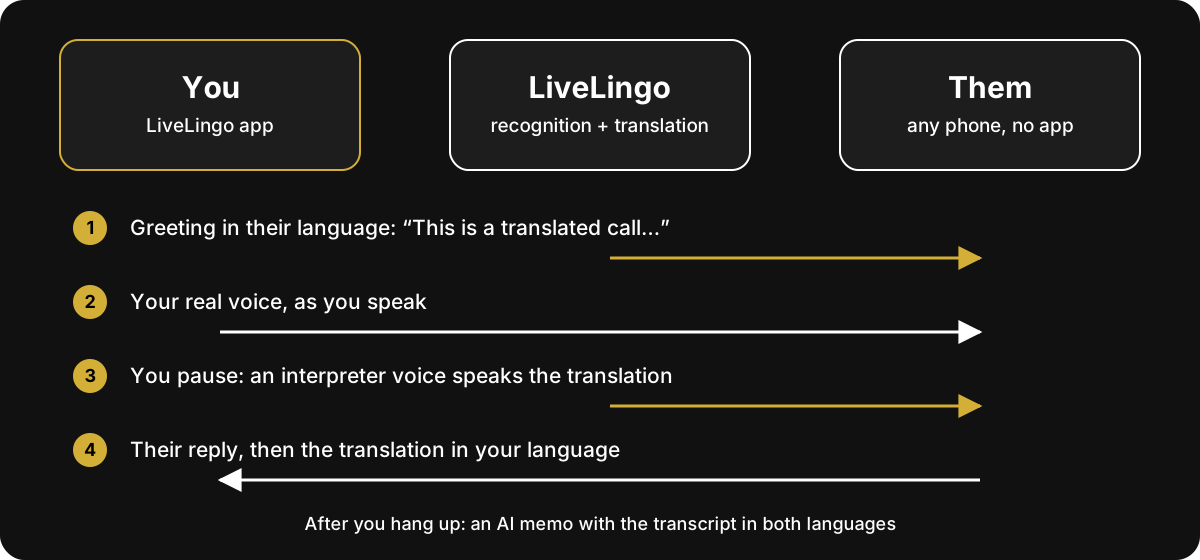
This is consecutive interpretation, the same turn-taking that professional phone interpreters use: one voice at a time, never two layered on top of each other.
5. Tips for a Smooth Call
- Text them first. The call comes from a number they don't know, so a quick message ("I'm calling you with a translator in a few minutes") makes them pick up.
- Say a translator is on the line. People are patient and cooperative once they know.
- Pause after each sentence. The translation plays when you stop talking. Short sentences translate better than long ones.
- Read numbers in small groups. Say a phone or reference number two or three digits at a time, and ask them to repeat it back.
- Use earbuds if you are somewhere noisy, so the microphone hears you and not the room.
- If they don't answer, leave a short voicemail. It is translated the same way: say who you are, why you are calling, and a number or time to reach you. Our Spanish voicemail templates help here.
6. When People Use It
- A partner or their family in Mexico or Spain who doesn't speak English. Your voice and laughter come through, which typing into a translator can't do.
- A contractor and a Spanish-speaking crew member sorting out tomorrow's job by phone. See construction Spanish for contractors.
- A landlord, tenant or neighbor about a repair, a delivery or a payment.
- A small business calling a Spanish-speaking customer back about an order or a booking.
For a medical, legal or financial decision, use a qualified human interpreter. A translated call is good for everyday conversations, not for consent forms or court.
7. What It Costs
Translated calls are part of LiveLingo Pro+ at $29.99 per month, which includes up to 90 call minutes a month and 500 minutes of translation. A single call can run up to 30 minutes. The minutes depend on the country you call: calls to US numbers use the standard rate (up to 90 minutes), calls to Spain use a higher rate (up to 60 minutes), and calls to Mexico use the premium rate (up to 30 minutes).
LiveLingo Pro ($19.99 per month) includes one 3-minute trial call, so you can try a real call before upgrading. All plans are on the pricing page.
8. Frequently Asked Questions
Is there a phone number I can call for a Spanish translator?
Yes. Pay-per-minute interpreter services such as LanguageLine Personal Interpreter ($3.95 per minute) and Day Interpreting (Spanish from $1.25 per minute) connect you to a live interpreter by phone or app after you create an account. If you just need to talk to one person, a translated call app like LiveLingo lets you call them directly instead.
Does the Spanish speaker need an app?
No. With LiveLingo they answer a normal phone call on any mobile or landline. They don't install anything, click a link or create an account.
Will they know the call is translated?
Yes. They hear a short greeting in Spanish that says it is a translated call and asks them to answer after each translation. Then they hear your real voice followed by a separate interpreter voice.
Does LiveLingo clone my voice?
No. The other person hears your real voice, then the translation in a separate interpreter voice. LiveLingo never imitates your voice.
Can I call a phone in Mexico or Spain?
Yes. LiveLingo calls mobiles and landlines in both countries. Calls to Spain use the higher rate (up to 60 minutes a month on Pro+) and calls to Mexico the premium rate (up to 30 minutes a month).
Is there a free way to do this?
If your phone supports it, yes: iPhone Live Translation, Samsung Live Translate and Pixel call translation are free, within their model and language limits. Health programs in the US that receive federal funding must also provide a free interpreter on request. LiveLingo's free plan covers in-person translation; translated phone calls need Pro+, with one 3-minute trial call on Pro.
If the person you need to reach only speaks Spanish, you don't need to find a bilingual friend or wait for an interpreter appointment. Place a translated call and they answer like any other call.