 LiveLingo
Quick Answer
- Learn the site basics first: start times ("Mañana empezamos a las siete"), safety ("¡Cuidado!", "Póngase el casco") and checking understanding ("¿Tiene alguna pregunta?"). Tables below.
- For anything longer, call them: with LiveLingo you speak English, they hear your voice and then Spanish on their own phone, and their reply comes back in English. They install nothing.
- Safety training is a separate obligation: OSHA requires required training to be given in a language workers understand. A phrase list or a call doesn't replace it.
1. Why Construction Spanish Matters
In 2025, 35.4% of people employed in US construction were Hispanic or Latino, compared with 20.0% across all industries, according to the Bureau of Labor Statistics (2025 annual averages, which exclude October 2025). Many of them are bilingual, and many are not.
Language also has a legal side. OSHA's training policy says employee training required by its standards must be presented in a manner employees can understand: "if an employee does not speak or comprehend English, instruction must be provided in a language the employee can understand."
2. Schedule and Start Times
| English | Spanish |
|---|---|
| We start tomorrow at seven. | Mañana empezamos a las siete. |
| We finish at four today. | Hoy terminamos a las cuatro. |
| No work tomorrow because of the rain. | Mañana no hay trabajo por la lluvia. |
| Can you work on Saturday? | ¿Puede trabajar el sábado? |
| The job site address is... | La dirección de la obra es... |
| Take a break. | Tome un descanso. |
3. Tasks and Materials
| English | Spanish |
|---|---|
| Today we are working on the second floor. | Hoy trabajamos en el segundo piso. |
| Please clean this area. | Por favor, limpie esta área. |
| Please take this over there. | Por favor, lleve esto allá. |
| How long do you need? | ¿Cuánto tiempo necesita? |
| We need more screws / nails / wood / cement. | Necesitamos más tornillos / clavos / madera / cemento. |
| The material delivery arrives at ten. | La entrega de material llega a las diez. |
| Tool | Spanish |
|---|---|
| ladder / scaffold | la escalera / el andamio |
| drill / saw | el taladro / la sierra |
| hammer / tape measure | el martillo / la cinta métrica |
| wheelbarrow / shovel | la carretilla / la pala |
4. Safety Phrases
| English | Spanish |
|---|---|
| Watch out! | ¡Cuidado! |
| Stop! | ¡Alto! |
| Put on your hard hat. | Póngase el casco. |
| Wear your safety glasses. | Use los lentes de seguridad. |
| Use the harness. | Use el arnés. |
| Don't use this ladder, it's damaged. | No use esta escalera, está dañada. |
| Are you hurt? | ¿Está lastimado? |
| Call 911. | Llame al 911. |
5. Checking Understanding
| English | Spanish |
|---|---|
| Do you understand? | ¿Entiende? |
| Do you have any questions? | ¿Tiene alguna pregunta? |
| Show me, please. | Muéstreme, por favor. |
| Repeat, please. | Repita, por favor. |
"Sí" doesn't always mean "I understood"; it can mean "I heard you." Asking someone to show you is the most reliable check.
6. Calling a Spanish-Speaking Crew Member
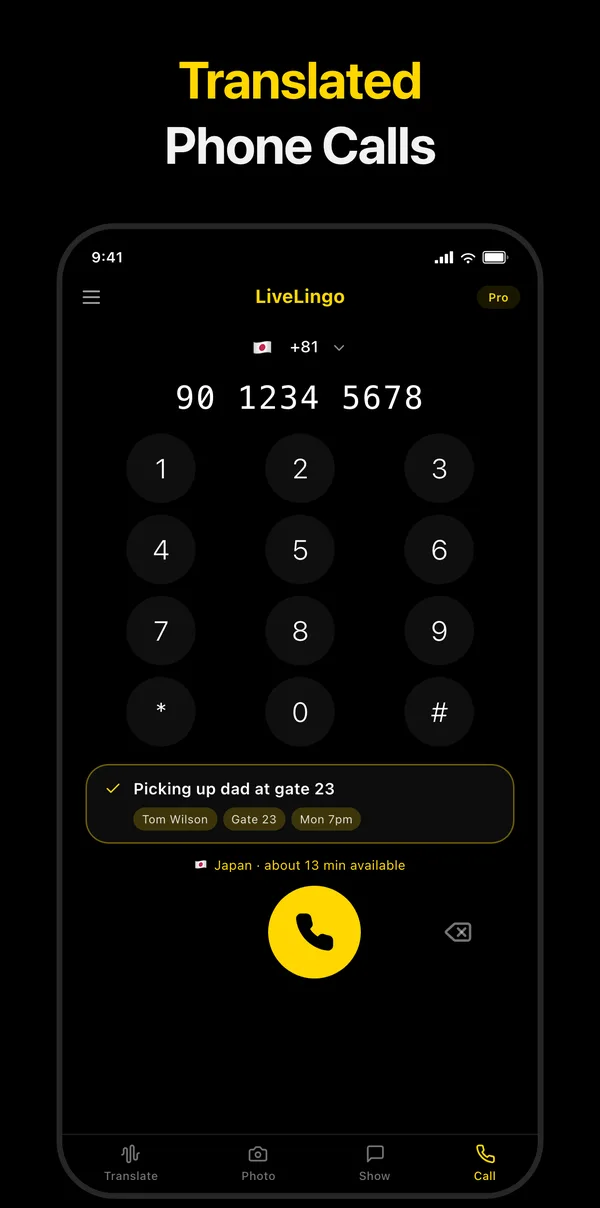
Phrases work face to face. On the phone, with no hands or diagrams to help, they break down fast. A translated call fills the gap:
- Open LiveLingo on your iPhone or Android phone and verify your number once by SMS.
- Choose Spanish as the other person's language and dial their normal mobile number.
- They hear a short greeting in Spanish ("Hola, es una llamada traducida de [your name] a través de LiveLingo. Responda después de cada traducción."), then your voice, then the Spanish translation.
- Their reply comes back to you in English. After the call you have the conversation written out in both languages.
Good uses: tomorrow's start time changed, directions to a new site, a material delivery running late, checking on someone who called in sick. Use the call to arrange things, not to deliver safety training.
Tips: tell the crew member once, in person, that you'll sometimes call through a translator, so an unknown number doesn't get ignored. Keep sentences short, and read addresses and times twice.
7. What It Costs
Translated calls are part of LiveLingo Pro+ at $29.99 per month, with up to 90 call minutes a month to US numbers and up to 30 minutes per call. Pro includes one 3-minute trial call. A contractor calling the whole crew every day will outgrow one plan; companies placing many calls can ask about team call plans at hello@livelingo.io.
8. Frequently Asked Questions
What are the most useful construction Spanish phrases?
Start with times ("Mañana empezamos a las siete"), safety ("¡Cuidado!", "¡Alto!", "Póngase el casco") and checking understanding ("¿Tiene alguna pregunta?", "Muéstreme, por favor").
How do I talk to a Spanish-speaking worker on the phone?
Call their normal number with a translated call app like LiveLingo. You speak English, they hear your voice and then Spanish, and their answer comes back to you in English. They don't need an app.
Does OSHA require training in Spanish?
OSHA requires required training to be presented in a manner employees can understand; if a worker doesn't understand English, instruction must be in a language they understand.
What share of construction workers speak Spanish?
The BLS counts ethnicity, not language: 35.4% of people employed in US construction were Hispanic or Latino in 2025. Many are bilingual.
Can I use a translated call for safety training?
No. Use it to arrange work: schedules, directions and deliveries. Required safety training should be delivered in the worker's language by a trainer who speaks it or with a qualified interpreter.
How much does it cost?
Translated calls are part of LiveLingo Pro+ at $29.99 per month, with up to 90 call minutes a month to US numbers. For whole crews, ask about team call plans at hello@livelingo.io.
A few phrases earn respect on site; a translated call handles the rest. Call your crew with LiveLingo and they answer on their own phone.