 LiveLingo
Quick Answer
- Personal greeting: "Hola, soy [nombre]. Ahora no puedo contestar. Déjame tu nombre y tu número, y te llamo lo antes posible. ¡Gracias!"
- Formal or business greeting: "Ha llamado a [nombre o empresa]. En este momento no podemos atender su llamada. Por favor, deje su nombre, su número y un breve mensaje, y le devolveremos la llamada lo antes posible."
- Leaving a message: "Hola, soy [tu nombre]. Te llamo por [motivo]. Por favor, llámame al [número]. Repito: [número]. Gracias."
- Don't speak Spanish? Call with LiveLingo: if they don't answer, the voicemail records your voice followed by the Spanish translation.
1. Personal Voicemail Greetings in Spanish
Use the informal version (tú) for friends and family, and the formal one (usted) if clients, landlords or people you don't know may call you.
| Style | Greeting |
|---|---|
| Casual | Hola, soy [nombre]. Ahora no puedo contestar. Déjame tu nombre y tu número, y te llamo lo antes posible. ¡Gracias! Hi, it's [name]. I can't answer right now. Leave me your name and number and I'll call you back as soon as I can. Thanks! |
| Short | Hola, soy [nombre]. Deja tu mensaje después del tono. Hi, it's [name]. Leave your message after the tone. |
| Formal | Buenos días, ha llamado a [nombre]. En este momento no puedo atender su llamada. Por favor, deje su nombre, su número de teléfono y un breve mensaje, y le devolveré la llamada lo antes posible. Gracias. Good morning, you've reached [name]. I can't take your call right now. Please leave your name, phone number and a short message, and I'll call you back as soon as possible. Thank you. |
2. Business and Bilingual Greetings
| Use | Greeting |
|---|---|
| Business hours | Gracias por llamar a [empresa]. Nuestro horario de atención es de lunes a viernes, de 9 de la mañana a 5 de la tarde. Por favor, deje su nombre, su número de teléfono y el motivo de su llamada, y nos comunicaremos con usted el siguiente día hábil. Thank you for calling [company]. Our hours are Monday to Friday, 9 a.m. to 5 p.m. Please leave your name, phone number and the reason for your call, and we'll get back to you the next business day. |
| Out of office | Hola, ha llamado a [nombre]. Estaré fuera de la oficina hasta el [fecha]. Si su asunto es urgente, comuníquese con [nombre] al [número]. Gracias. Hello, you've reached [name]. I'll be out of the office until [date]. If it's urgent, please contact [name] at [number]. Thank you. |
| Bilingual | Hello, you've reached [name or company]. Please leave your name, number and a short message after the tone. Hola, ha llamado a [nombre o empresa]. Por favor, deje su nombre, su número y un breve mensaje después del tono. Thank you, gracias. |
For a bilingual greeting, say the English part first if most of your callers speak English, and keep both halves short so callers aren't waiting through a long recording before the beep.
3. Leaving a Voicemail in Spanish
A good voicemail has three parts: who you are, why you are calling, and how to reach you. Say your number twice, slowly.
| Situation | Message |
|---|---|
| Asking for a callback (informal) | Hola, [nombre], soy [tu nombre]. Te llamo por [motivo]. Por favor, llámame al [número]. Repito: [número]. Gracias, hasta luego. Hi [name], it's [your name]. I'm calling about [reason]. Please call me at [number]. Again: [number]. Thanks, talk soon. |
| Confirming an appointment (formal) | Buenos días, le habla [nombre] de [empresa]. Le llamo para confirmar su cita del [día] a las [hora]. Si necesita cambiarla, llámenos al [número]. Muchas gracias. Good morning, this is [name] from [company]. I'm calling to confirm your appointment on [day] at [time]. If you need to change it, call us at [number]. Thank you very much. |
| Arriving or delivering | Hola, soy [nombre]. Le llamo para avisarle que mañana llegamos a las ocho de la mañana. Si hay algún problema, llámeme al [número]. Gracias. Hi, this is [name]. I'm calling to let you know we'll arrive tomorrow at eight in the morning. If there's any problem, call me at [number]. Thank you. |
Phone numbers: the clearest way is to say each digit on its own, using cero for 0: "cinco, cinco, cero, uno, dos...". It is slower than reading the number in pairs, but nobody mishears it.
| Digit | Spanish |
|---|---|
| 0 / 1 / 2 / 3 / 4 | cero / uno / dos / tres / cuatro |
| 5 / 6 / 7 / 8 / 9 | cinco / seis / siete / ocho / nueve |
4. How to Leave a Spanish Voicemail Without Speaking Spanish
If you need to reach someone who only speaks Spanish and they don't pick up, you can still leave a message they will understand. Call their normal number with LiveLingo and choose Spanish as their language. When their voicemail answers:
- Wait for their voicemail greeting and the beep. The greeting is translated for you as it plays.
- Speak in English in short sentences, pausing after each one. The voicemail records your voice, then the Spanish translation.
- Say who you are, why you are calling, and the best number to reach you, and say the number twice.
- Hang up. The message in their mailbox is in your voice and in Spanish.
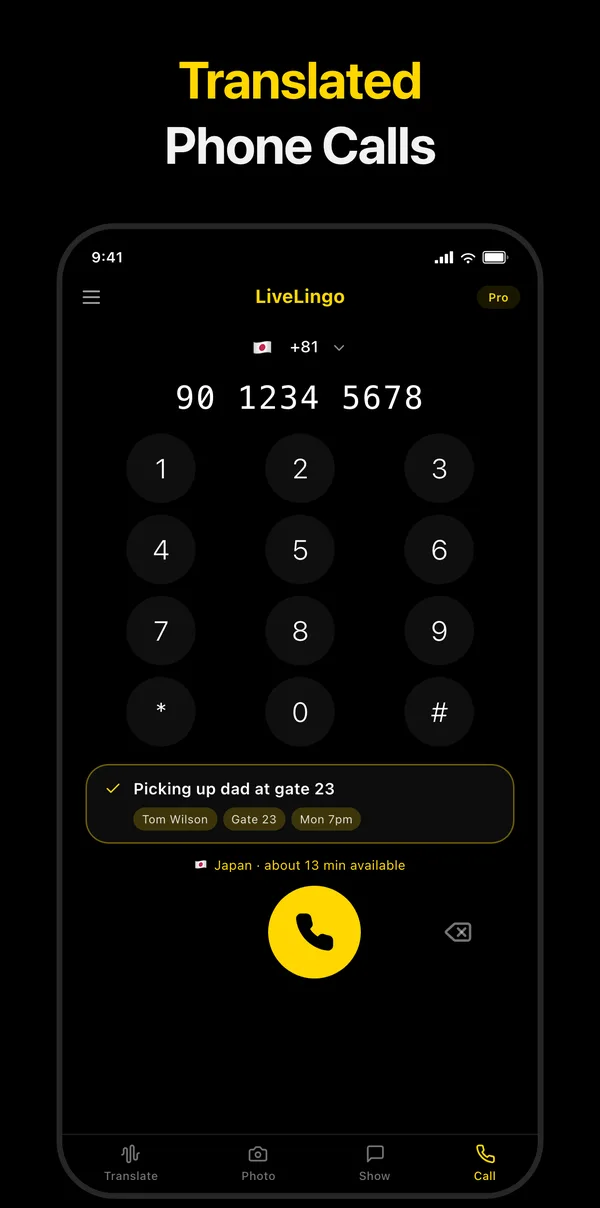
Translated calls are part of LiveLingo Pro+ ($29.99 per month, up to 90 call minutes a month to US numbers). A voicemail usually takes under a minute. Our guide to talking on the phone with someone who only speaks Spanish covers live calls.
5. Understanding a Voicemail You Received in Spanish
If someone left you a voicemail in Spanish, play it on speaker and let a conversation translator listen. In the LiveLingo app, open the Translate tab, set Spanish and English, and play the message next to your phone; the translation appears as it plays. To reply, call them back with a translated call.
6. Frequently Asked Questions
What do you say on a voicemail greeting in Spanish?
A simple personal greeting is "Hola, soy [nombre]. Ahora no puedo contestar. Déjame tu nombre y tu número, y te llamo lo antes posible." For a formal or business line, use usted: "Ha llamado a [nombre]. Por favor, deje su nombre, su número y un breve mensaje."
How do you say "leave a message after the tone" in Spanish?
Informal: "Deja tu mensaje después del tono." Formal: "Deje su mensaje después del tono."
How do I leave a voicemail in Spanish?
Say who you are, why you are calling and how to reach you: "Hola, soy [tu nombre]. Te llamo por [motivo]. Por favor, llámame al [número]." Say your number twice, one digit at a time.
Can I leave a voicemail in Spanish if I don't speak Spanish?
Yes. Call with LiveLingo and choose Spanish. If they don't answer, wait for the beep and speak English in short sentences; the voicemail records your voice followed by the Spanish translation.
Should my voicemail greeting be bilingual?
If you regularly get calls from both English and Spanish speakers, yes. Keep both halves short and put the language most of your callers speak first.
How do I understand a voicemail left in Spanish?
Play it on speaker next to a conversation translator, such as the LiveLingo Translate tab, and the translation appears as it plays.
A clear voicemail in the other person's language gets more calls returned. If your Spanish isn't there yet, call with LiveLingo and leave the message in your own words.