 LiveLingo
1. Japanese Greetings and Farewells You'll Use Every Day
Tap and speak
Show me anything you need to say
The four core Japanese greetings depend entirely on the time of day. Use ohayou gozaimasu before 11 AM, konnichiwa for standard daytime interactions, and konbanwa after sunset. Casual situations with close friends call for a simple ohayou instead.
Foreign travelers frequently miss the subtle social cues that these basic greetings provide. For almost any daytime situation, you can safely rely on the standard greeting konnichiwa without offending anyone.
Goodbye Phrases and When Each One Fits
Sayounara carries a weight that most textbooks don't warn you about — it implies you won't see this person again for a long time, possibly ever. For anything short of a permanent farewell, mata ne or jaa ne are what you actually want.
Just keep those casual goodbyes away from business settings entirely. I've watched a perfectly warm client dinner go cold because someone said the wrong goodbye at the door.
That social friction brings us to the most important concept in Japanese communication: politeness levels.
2. Polite Expressions That Make a Real Difference
Sumimasen: The One Word That Does Everything
Rarely does a single vocabulary word carry as much weight as sumimasen during your daily life in Japan. It acts as an apology, an attention request, and a buffer. You will use it constantly.
If you bump into someone on the crowded subway, say sumimasen. For requesting favors, deploy onegaishimasu instead. Onegaishimasu lands as a genuine request; kudasai alone can read as a demand.
At a factory in Osaka, I watched a junior buyer from our team address the factory owner using plain-form Japanese — the kind you'd use with a close friend. The owner's expression didn't change, but his quoted lead time suddenly stretched from three weeks to six. Nobody said anything. The financial penalty for bad manners was immediately obvious to everyone in the room.
Understanding Keigo — Japan's Politeness System in Plain English
Keigo is Japan's formal speech system, divided into three tiers. Travelers need only the middle tier — teineigo — which uses standard masu-form and desu-form endings. Using the casual form with your boss in Japan implies you are equals, or worse, that they are beneath you.
| English Meaning | Casual Form (Friends/Family) | Polite Form (Teineigo - Strangers/Colleagues) |
|---|---|---|
| I understand | Wakatta | Wakarimashita |
| Thank you | Arigatou | Arigatou gozaimasu |
| Please do this | Yoroshiku | Yoroshiku onegaishimasu |
| Is it okay? | Ii? | Ii desu ka? |
The politeness rules above determine which column of the tables below you should be using.
3. 50+ Essential Japanese Phrases for Beginners
Scenario-based learning beats memorizing grammar rules in isolation. The tables below cover the essential Japanese phrases for beginners you'll actually reach for — organized by situation, not by textbook chapter.
Greetings and Farewells
| Japanese (Romaji) | English Meaning | Formality Level | Best Use Context |
|---|---|---|---|
| Ohayou gozaimasu | Good morning | Polite | Greeting anyone before 11 AM |
| Konnichiwa | Hello / Good afternoon | Polite | Standard daytime greeting |
| Konbanwa | Good evening | Polite | Greeting anyone after sunset |
| Mata ne | See you later | Casual | Saying goodbye to friends |
Basic Polite Expressions
| Japanese (Romaji) | English Meaning | Formality Level | Best Use Context |
|---|---|---|---|
| Arigatou gozaimasu | Thank you very much | Polite | Thanking staff or strangers |
| Sumimasen | Excuse me / I'm sorry | Polite | Getting attention or apologizing |
| Hai | Yes | Polite | Confirming information |
| Iie | No | Polite | Denying information |
| Onegaishimasu | Please (favor) | Polite | Requesting a service |
| Kudasai | Please (item) | Polite | Asking for a physical object |
| Wakarimashita | I understand | Polite | Confirming instructions |
| Wakarimasen | I don't understand | Polite | Expressing confusion |
| Eigo ga hanasemasu ka? | Do you speak English? | Polite | Finding an English speaker |
| Ikura desu ka? | How much is it? | Polite | Asking for a price |
| Shashin wo totte mo ii desu ka? | Can I take a photo? | Polite | Asking permission |
| Daijoubu desu | It's okay / I'm fine | Polite | Reassuring someone |
| Chotto matte kudasai | Please wait a moment | Polite | Asking for time |
| Mou ichido onegaishimasu | One more time, please | Polite | Asking someone to repeat |
| Yukkuri hanashite kudasai | Please speak slowly | Polite | Struggling to understand |
Dining and Restaurants
| Japanese (Romaji) | English Meaning | Formality Level | Best Use Context |
|---|---|---|---|
| Kore wo kudasai | I'll take this | Polite | Ordering food or buying items |
| Menyu wo kudasai | Menu, please | Polite | Sitting down at a restaurant |
| Okanjo onegaishimasu | The bill, please | Polite | Finishing a meal |
| Itadakimasu | Let's eat | Polite | Said before starting a meal |
| Gochisousama deshita | Thanks for the meal | Polite | Said after finishing a meal |
| Oishii desu | It's delicious | Polite | Complimenting the chef |
| Mizu wo onegaishimasu | Water, please | Polite | Asking for water |
| Arerugi ga arimasu | I have an allergy | Polite | Warning restaurant staff |
| Yoyaku shite imasu | I have a reservation | Polite | Hotel or restaurant check-in |
Navigation and Transport
| Japanese (Romaji) | English Meaning | Formality Level | Best Use Context |
|---|---|---|---|
| Doko desu ka? | Where is it? | Polite | Asking for directions |
| Toire wa doko desu ka? | Where is the toilet? | Polite | Finding a restroom |
| Eki wa doko desu ka? | Where is the station? | Polite | Finding train transportation |
| Hidari | Left | Neutral | Listening to directions |
| Migi | Right | Neutral | Listening to directions |
| Massugu | Straight | Neutral | Listening to directions |
| Michi ni mayoimashita | I am lost | Polite | Asking police for help |
| Heya wa doko desu ka? | Where is the room? | Polite | Finding your hotel room |
Emergencies
| Japanese (Romaji) | English Meaning | Formality Level | Best Use Context |
|---|---|---|---|
| Tasukete! | Help! | Casual/Urgent | Emergency situations |
| Keisatsu wo yonde! | Call the police! | Casual/Urgent | Reporting a crime |
| Isha ga hitsuyou desu | I need a doctor | Polite | Medical emergencies |
| Kyukyusha wo yonde! | Call an ambulance! | Casual/Urgent | Severe medical emergencies |
Business and Formal
| Japanese (Romaji) | English Meaning | Formality Level | Best Use Context |
|---|---|---|---|
| O-namae wa? | What is your name? | Polite | Meeting someone new |
| Watashi wa [Name] desu | I am [Name] | Polite | Introducing yourself |
| Yoroshiku onegaishimasu | Nice to meet you | Polite | Formal introductions |
| Ogenki desu ka? | How are you? | Polite | Formal small talk |
| O-shigoto wa? | What is your job? | Polite | Business small talk |
| Osewa ni natte orimasu | Thank you for your support | Formal | Greeting business clients |
| Choudai itashimasu | I humbly receive this | Formal | Accepting a business card |
Slang and Casual
| Japanese (Romaji) | English Meaning | Formality Level | Best Use Context |
|---|---|---|---|
| Genki? | How are you? | Casual | Small talk with friends |
| Sugoi | Amazing | Casual | Reacting to good news |
| Yabai | Crazy / Intense | Casual | Reacting to extreme situations |
| Maji de? | Seriously? | Casual | Expressing disbelief |
When these phrases aren't enough, LiveLingo's Show tab lets you translate in real time — no typing required.
4. Practical Japanese Phrases for Real Travel Scenarios
When Your Phrases Fail: Digital Backup
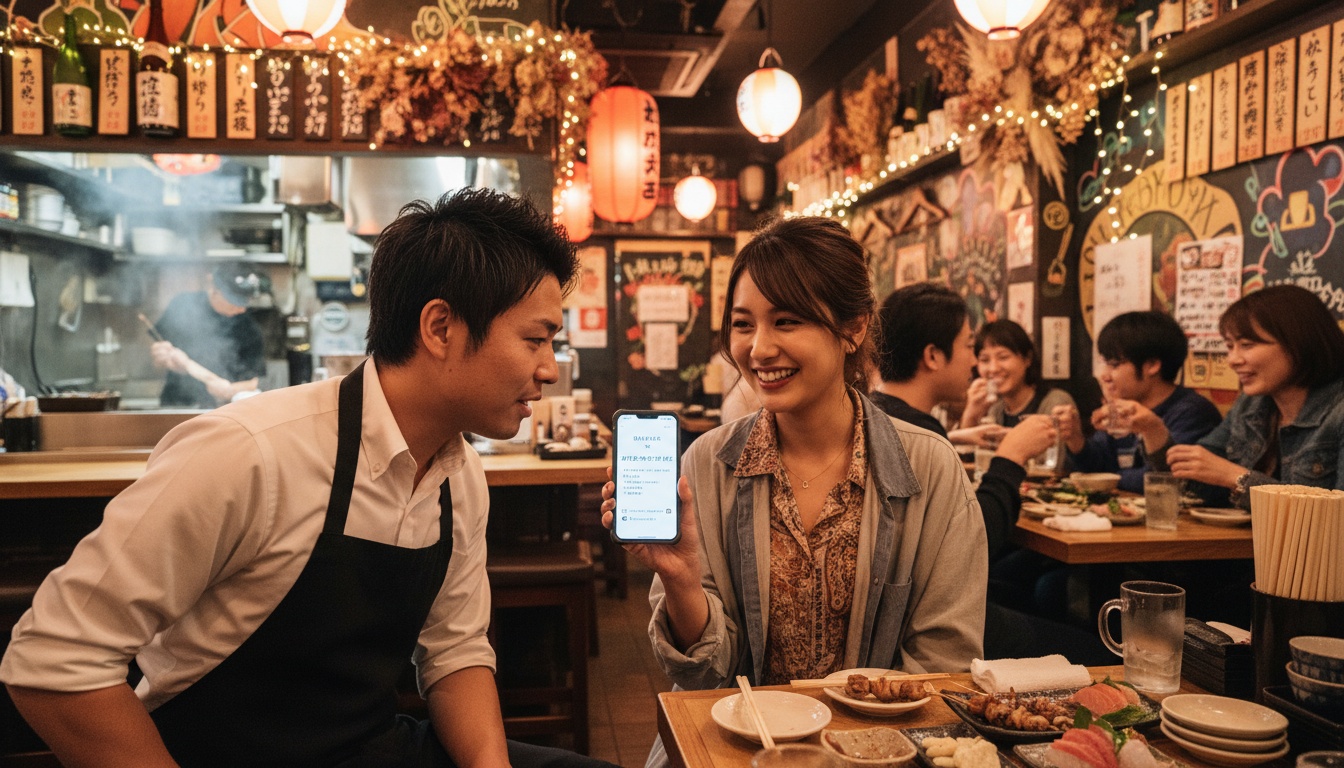
In a Shinjuku izakaya with no English menu last spring, I pulled up LiveLingo's Show tab and held my phone toward the server. She read the translated request instantly over the loud music.
Navigation and Transport
At the airport, ask "Doko desu ka?" to find the exit, but locate an English speaker first. Always ask "Eigo ga hanasemasu ka?" before assuming they understand your English.
Emergency Phrases You Hope to Never Use
Emergencies demand immediate and clear communication. If you ever find yourself in a dangerous situation needing urgent help, yell "Tasukete!" When lost, tell the police "Michi ni mayoimashita."
Medical Phrases That Could Save Your Life
Medical situations require specific vocabulary. State "Isha ga hitsuyou desu" when you need a doctor immediately. To prevent a dangerous allergic reaction, clearly state "[Ingredient] no arerugi ga arimasu" to warn the chef.
Dining Phrases That Go Beyond "Arigato"
Say itadakimasu before you begin eating to show gratitude for the food and its preparers. When finished, a simple gochisousama deshita shows respect to the chef.
Request the menu by saying "Menyu wo kudasai" to the server. Order by pointing. Say "Kore wo kudasai" while clearly indicating your choice.
Social situations are forgiving. Business situations are not — the stakes are higher and the vocabulary shifts accordingly.
5. Japanese Business Phrases for Professionals
In Japanese business culture, using the wrong speech register can cost you the contract before negotiations begin. Taking the time to master Japanese business phrases prevents expensive misunderstandings during tense negotiations.
Always greet clients with "Osewa ni natte orimasu" to acknowledge your ongoing relationship. Exchange business cards carefully. Say "Choudai itashimasu" when receiving their card to show proper respect.
6. Japanese Phrase Mistakes That Will Get You in Trouble
- Skipping sumimasen before approaching a stranger: Without this buffer, you seem rude. Approaching someone cold in Tokyo feels jarring to the local listener.
- Saying arigatou to a shopkeeper or senior: The short form is what you'd say to a child or a close friend. It accidentally signals that you don't take the interaction seriously.
- Answering hai to a negative question:* According to traditional Japanese conversational logic, hai* simply confirms that the negative statement is factually correct. This confuses many English speakers.
7. Casual Japanese, Slang, and Small Talk You'll Actually Hear
How to Use Yabai Without Embarrassing Yourself
Formal speech dominates business, but casual speech rules the streets. Yabai is completely context-dependent. Younger speakers use it to mean anything from "this ramen is insane" to "we're going to miss the last train."
Tone and facial expression do all the work. Don't try to use it until you've heard it in context at least a dozen times.
Regional Dialects: What to Do When You Don't Recognize a Word
Regional dialect variation exists across the country. In the famous Kansai dialect, locals frequently use the word "ookini" for thank you. Kyoto-ben speakers say "oideyasu" to welcome customers.
If you're traveling outside Tokyo, don't panic if locals respond with words you don't recognize. Standard Japanese, known as hyojungo, remains universally understood.
8. How to Pronounce Japanese Phrases (And Avoid the Most Common Errors)
- The five vowels are pure: Using basic IPA helps you master these sounds quickly.
- 'U' is unrounded: It sounds very different from the heavy English "oo" sound.
- 'Desu' is one syllable: des': Saying "deh-SOO" instantly marks you as a beginner.
- Pitch accent, not stress: This unique system relies on high and low pitches rather than heavy English stress.
- Learn hiragana early: Relying entirely on romaji trains incorrect pronunciation habits long-term.
Listen and repeat with native audio before relying on text. We highly recommend free resources like NHK World, Forvo, YouGlish, and Tofugu for authentic listening practice.
Learning Japanese writing systems early builds a solid foundation for your Japanese language learning journey.
9. What to Learn After These 50 Phrases
Human interpreters typically charge between $1.25 and $4.95 per minute. Digital tools cost a fraction of that, often around $0.07 per minute for premium features based on LiveLingo's current pricing.
If you want to practice these phrases with a safety net, try LiveLingo free — it covers real-time voice translation for exactly the moments this article describes.
Start with five phrases this week — not fifty. Pick the scenario you'll hit first, whether that is the airport or a hotel, and drill those phrases until they're automatic. The rest can wait.