 LiveLingo
Quick Answer
- For everyday messages: WhatsApp and iPhone Messages both translate texts now. Fast and free, but no voice.
- For video calls: FaceTime shows translated live captions on supported iPhones, and Samsung Live Translate works inside WhatsApp calls on supported Galaxy phones.
- For phone calls when either phone isn't supported: call your partner's normal number from LiveLingo. They answer like any call, hear your real voice, then the translation in their language. Nothing to install on their side.
- For the long run: learn each other's language. The after-call transcript in both languages helps.
1. What Works for Couples Who Don't Share a Language
| Option | Best for | What your partner needs | Limits |
|---|---|---|---|
| Texting with translation (WhatsApp, iPhone Messages) | Daily messages, plans, photos | The same app | No voice or tone; easy to misread emotion |
| Video call with translated captions (FaceTime) | Seeing each other | An iPhone, Mac or iPad on FaceTime | Captions only, no spoken translation; needs a supported iPhone with Apple Intelligence |
| Built-in call translation (iPhone, Galaxy, Pixel) | Phone calls if your phone and language are supported | Nothing; it runs on your phone | Specific phone models and a short language list; see which phones can translate calls |
| LiveLingo translated call | Real voice conversations from any phone | Nothing; any mobile or landline | You speak, pause, then the translation plays; monthly call minutes |
| Learning each other's language | The long term | Time and patience | Takes months before you can talk about anything important |
Most couples use a mix: texts during the day, a call in the evening, and a few words of each other's language that grow over time.
2. What a Translated Call Actually Feels Like
A translated call is not two people talking over each other with instant subtitles. It works like a call with an interpreter on the line:
- Your partner's phone rings like any call. In 15 languages, including Spanish, Japanese, Russian and Portuguese, they first hear a short greeting in their language saying it is a translated call from you.
- They hear your real voice while you speak, so your tone, your laugh and your hesitation come through.
- You pause, and the translation plays in a separate interpreter voice. LiveLingo never clones your voice, so your partner always knows which part is you.
- They answer in their language, and you hear their voice, then the translation in yours.
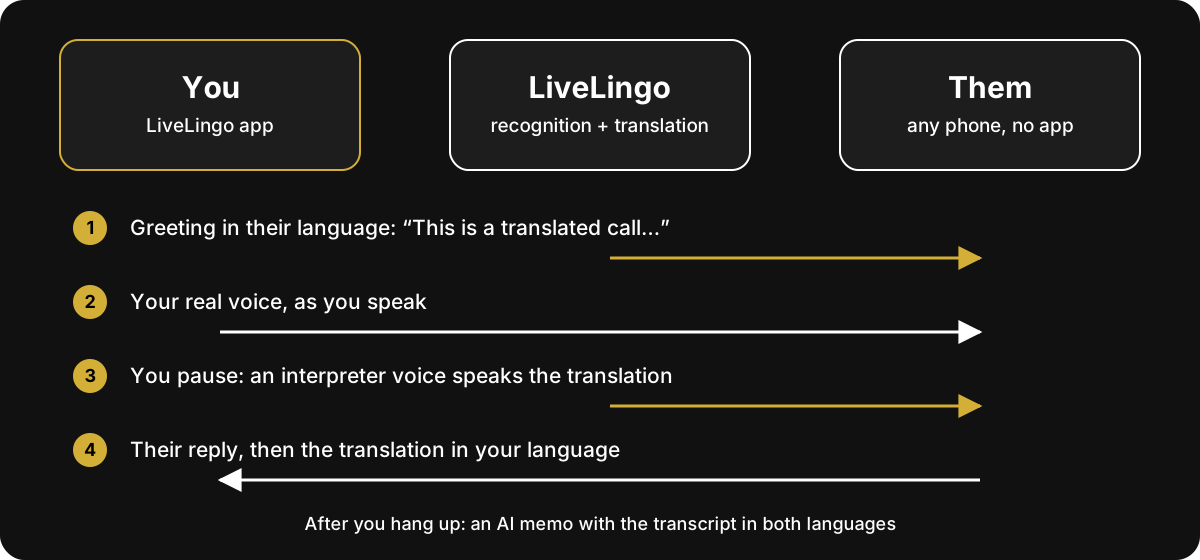
Be honest with yourselves about the trade-off. Every sentence takes a little longer, the greeting plays at the start of every call, and hearing your own words come back in another voice feels odd at first. Most of that fades after a few calls, once you both settle into the rhythm of speaking and pausing.
3. Tips for Calls With Your Partner
- Text them before the first call. The call comes from a number they don't know. A quick "I'm calling you with a translator" makes sure they pick up.
- Use earbuds. It keeps the call clear and makes it feel private.
- One person at a time. Wait for the translation to finish before answering, or the two voices get mixed up.
- Short sentences. Two short sentences translate better than one long one with three ideas in it.
- Go easy on slang and jokes. Wordplay rarely survives translation. If something lands wrong, say what you meant more plainly.
- Learn from the transcript. After each call you get the conversation written out in both languages. Pick a few phrases and learn them; your partner can do the same.
4. Talking to Your Partner's Parents
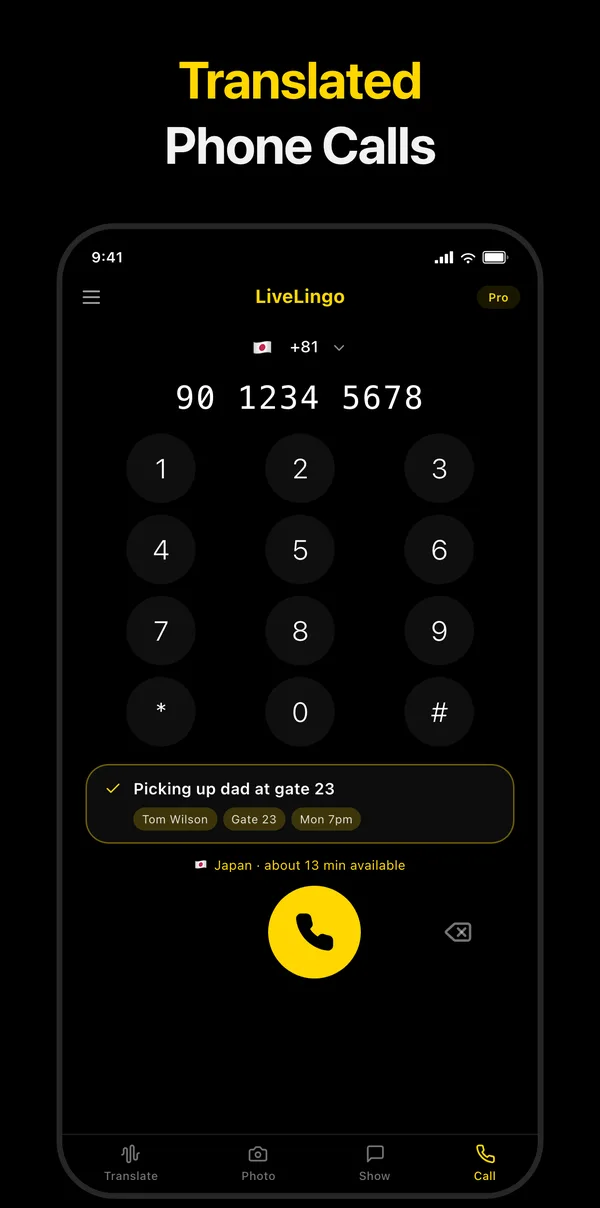
Meeting the family is where the language gap hurts most. Parents and grandparents often don't use messaging apps the way you do, and some only have a landline. A translated call reaches any mobile or landline number, opens with a greeting in their language that explains what kind of call it is, and lets them hear your real voice. Keep the first call short and warm: introduce yourself, thank them, and ask one or two simple questions.
Our guide to family language barriers covers more ways to bridge generations.
5. What It Costs, Honestly
Texting with translation and the built-in phone features are free. LiveLingo translated calls are part of Pro+ at $29.99 per month, which includes up to 90 call minutes a month and up to 30 minutes per call. The minutes depend on the country you call: calls to the US use the standard rate (up to 90 minutes a month), calls to Spain or Japan use a higher rate (up to 60 minutes), and calls to Mexico use the premium rate (up to 30 minutes).
That is enough for a few good calls a week, not a two-hour call every night. Couples who talk daily usually keep the translated calls for the conversations that matter and use texts and video for the rest. LiveLingo Pro ($19.99 per month) includes one 3-minute trial call, so you can try it with your partner first. See the pricing page.
6. Frequently Asked Questions
How do couples who don't speak the same language talk on the phone?
They use call translation: either the built-in feature on a supported iPhone, Galaxy or Pixel, or a translated call app like LiveLingo that calls the partner's normal number. Each person speaks their own language and hears the other in theirs, with a short pause for the translation.
Does my partner need to install an app?
No. With LiveLingo your partner answers a normal phone call on any mobile or landline. They don't install anything or create an account.
Will my partner hear my real voice?
Yes. They hear your real voice while you speak, then the translation in a separate interpreter voice. LiveLingo never clones or imitates your voice.
Can I call my partner's parents on a landline?
Yes. LiveLingo calls any mobile or landline number, and in 15 languages the call opens with a greeting in their language that explains it is a translated call.
How long can a translated call last?
Up to 30 minutes per call on LiveLingo Pro+, within a monthly pool of up to 90 minutes to US numbers, 60 to countries such as Spain and Japan, and 30 to countries such as Mexico.
Is there a free way for couples to talk across languages?
Yes, for texting: WhatsApp and iPhone Messages translate messages for free. FaceTime shows translated captions on supported iPhones. Translated phone calls from any phone need LiveLingo Pro+, with one 3-minute trial call on Pro.
A language gap doesn't have to mean typing every conversation. Call your partner with LiveLingo and let them hear your voice, in their language.