 LiveLingo
1. What Makes a French to English Translation Tool Worth Using?
A good French-to-English translation tool must handle grammar differences, register distinctions (formal vous vs. casual tu), and context-dependent meanings that word-for-word substitution misses. Three approaches dominate: AI tools for speed, human services for nuance, and hybrid methods for high-stakes content.
Tap and speak in French
Tap to start
French grammar structures sentences differently, uses gendered nouns, and carries register distinctions that English simply doesn't encode the same way. A tool that translates word-for-word will produce technically readable but often tonally wrong output.
Three methods dominate the space in 2026:
- AI-powered translation (DeepL, Google Translate, Microsoft Translator) — instant translation at zero cost, covers most daily needs
- Human translation services — catches idiom, subtext, and industry-specific terminology that AI misses
- Hybrid approaches — AI draft plus professional editing, best accuracy-to-cost ratio for high-stakes content
Free tools handle casual and travel needs without any real trade-off. The evaluation criteria throughout this article: accuracy on real-world sentences, speed, cost, offline support, document translation capability, and fit for specific use cases.
---
2. Best French to English Translation Tools Compared
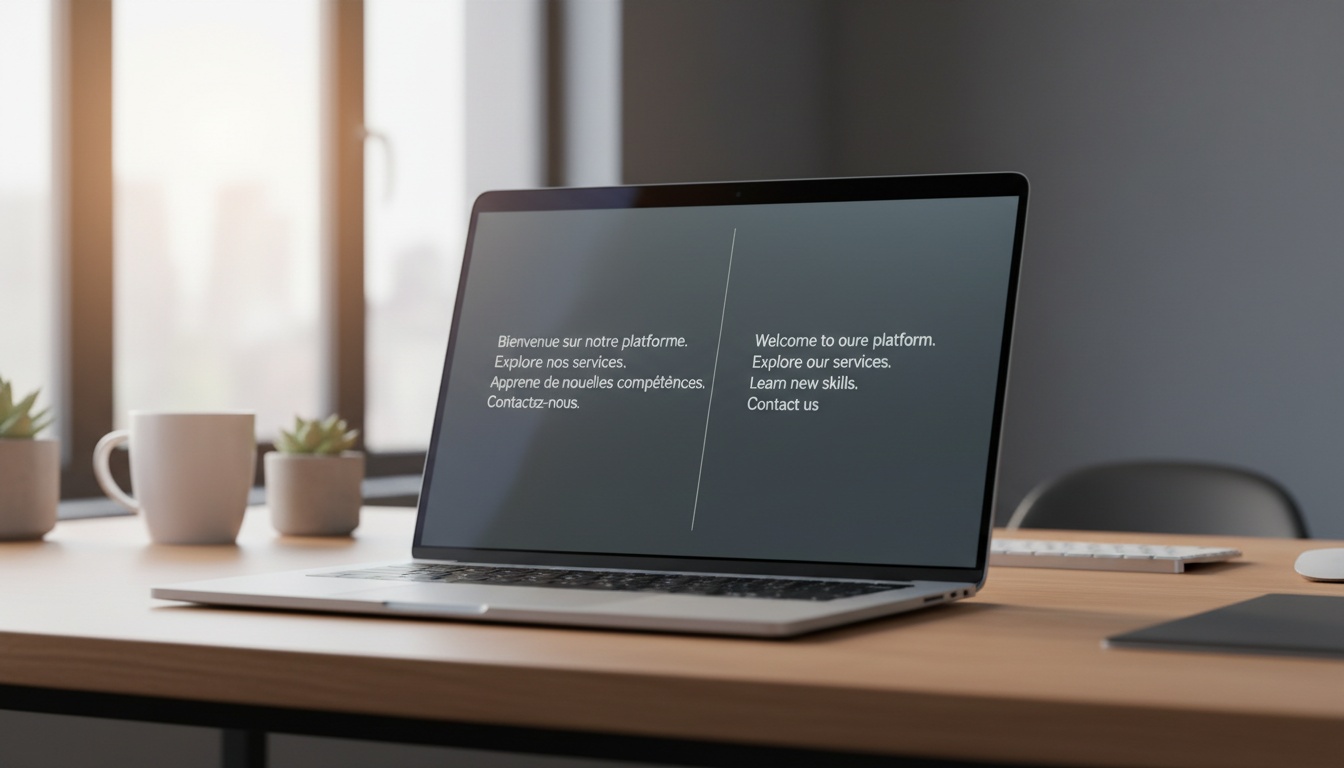
Based on testing in early 2026, the accuracy gap between the top tools has narrowed for standard French-to-English sentence translation. DeepL's neural engine update, rolled out in late 2025, brought its everyday accuracy closer to parity with Google Translate on common sentence pairs. The gap that made DeepL the obvious default in previous years has genuinely closed for routine use.
Where they still diverge is tone, formality, and idiomatic handling.
| Tool | Cost | Best Use Case | Offline Support |
|---|---|---|---|
| DeepL | Free / ~$8-9/mo Pro | Business, formal writing | Pro only |
| Google Translate | Free | Travel, casual, real-time | Yes (downloaded packs) |
| Microsoft Translator | Free / enterprise pricing | Business, Office integration | Yes |
| Reverso | Free / ~$10/mo | Grammar context, learning | No |
| WordReference | Free | Dictionary lookup, nuance | No |
See tool-specific sections below for document translation capabilities and known weaknesses. Pricing based on publicly listed rates at time of writing — verify current pricing on each provider's site.
Best Free French to English Tools
Google Translate remains the default for good reason. I've defaulted to its camera mode more times than I can count — pointing my phone at a handwritten menu and getting a readable translation in under two seconds is fast enough to be genuinely useful in a moving situation. Downloaded language packs give you offline access, and the audio translation feature lets you hear pronunciation on unfamiliar words. The mobile app is clean and ad-free.
Reverso is underrated for anyone who wants to understand why a translation works. It shows the translated sentence alongside real-world usage examples pulled from published texts, which is how you learn whether a word choice sounds natural or just technically correct. The free tier has daily limits on the context feature, but for casual use it holds up.
For business content where free tools fall short, [see how professional translation services handle register and industry terminology][INTERNAL: professional-french-translation-service] — the gap is most visible in formal documents.
WordReference isn't a sentence translator — it's a bilingual dictionary with active forums where native speakers debate nuance. Use it alongside AI tools to verify whether a specific word choice actually sounds natural in context.
Best Tools for Document Translation (PDF, Word)
DeepL Pro is the strongest option for document translation, supporting PDF, Word, and multiple formats with layout preservation. Your translated file comes back looking like the original rather than a wall of unstyled text that needs manual cleanup. Google Translate's document upload works for basic PDFs but struggles with complex layouts.
For professional document translation at scale, translate.com's French-English service supports .txt, .pdf, .doc(x), .xls(x), .odt, .rtf, .ppt(x), .xliff, .csv, .po, .indd, .idml, .ai, and .fig files through verified human translators (check their current documentation for the latest format list). That matters for legal or design-heavy files where AI output alone won't cut it.
Best Offline French to English Translation Options
Download Google Translate's offline packs before you travel — you'll have full translation access even when restaurant Wi-Fi is down or you're in a low-signal area. The French pack covers the full translation feature set. iTranslate offers offline dictionaries with audio pronunciation guides, which matters when you're in a low-signal area trying to confirm how to say something aloud.
Download offline packs before you travel, not after you've lost signal.
Offline translation matters more than most people plan for. Medical or emergency situations don't wait for a Wi-Fi connection.
Browser Extensions Worth Knowing
Both DeepL and Google Translate offer browser extensions that translate selected text or entire pages in real time. Highly relevant if you're regularly reading French news, supplier websites, or academic sources. The DeepL extension handles formal register better on business pages; Google Translate's extension is faster for casual browsing. Both are free.
---
3. Common French to English Translation Mistakes and How to Avoid Them
French grammar creates predictable errors in English output. Knowing the patterns in advance saves real frustration.
Five False Cognates That Cause the Most Errors
These are faux amis — false cognates that look familiar but carry entirely different meanings. Every French-to-English translator, human or AI, gets tripped up by them when context is ambiguous.
| French Word | Assumed English Meaning | Actual English Meaning |
|---|---|---|
| Sensible | Sensible | Sensitive |
| Actuellement | Actually | Currently |
| Éventuellement | Eventually | Possibly |
| Formidable | Formidable | Wonderful/Great |
| Rester | Rest | To stay/remain |
Tense Confusion
The passé composé maps to the English simple past in most cases — "J'ai mangé" = "I ate." Context is everything here. AI tools sometimes render it as present perfect ("I have eaten") when the surrounding context doesn't support that reading, and for business translation or academic work, that distinction matters more than it might seem.
Register Mismatch
This one is subtler. A formal French email closing like "Veuillez agréer, Monsieur, l'expression de mes sentiments distingués" is the functional equivalent of "Yours sincerely" — not "Please accept, Sir, the expression of my distinguished sentiments," which is what a literal AI translation produces. DeepL handles this better than most. Always read formal closings manually regardless of which tool you use.
Gendered Nouns Bleeding into English
This shows up when translators carry over French article patterns. "La décision était bonne" should be "The decision was good" — not "She was a good decision," which happens with low-quality tools that mishandle pronoun resolution.

---
4. Why AI Translation Fails on French Idioms (And What to Do Instead)
Idioms are where every AI-powered translation tool shows its limits. A French idiom translated literally produces output that's grammatically correct and completely meaningless to an English reader.
Eight French Idioms That Defeat Every AI Translation Tool
- "Avoir le cafard" — Literal: to have the cockroach. Actual meaning: to feel down/depressed.
- "Casser les pieds" — Literal: to break the feet. Actual meaning: to annoy someone.
- "Il ne faut pas pousser mémé dans les orties" — Literal: don't push grandma into the nettles. Actual meaning: don't push your luck.
- "Poser un lapin" — Literal: to place a rabbit. Actual meaning: to stand someone up.
- "Avoir le beurre et l'argent du beurre" — Literal: to have the butter and the butter money. Actual meaning: to have your cake and eat it too.
- "Les carottes sont cuites" — Literal: the carrots are cooked. Actual meaning: it's over, there's no way out.
- "Tomber dans les pommes" — Literal: to fall into the apples. Actual meaning: to faint.
- "Faire la grasse matinée" — Literal: to do the fat morning. Actual meaning: to sleep in.
None of these translate accurately through any free translation tool. Google Translate gives you the literal version. DeepL sometimes catches the idiomatic meaning if the surrounding context is clear enough — when I ran "Les carottes sont cuites" through DeepL with no surrounding sentence, it returned the literal translation. With a full paragraph of context about a failed negotiation, it got closer to the figurative meaning. Still not reliable enough to trust without verification.
How Do You Say "I Miss You" in French — and What Does It Really Mean?
"Tu me manques" is French for "I miss you." Literally, it means "you are missing from me" — the subject and object reverse compared to English. For a flirty register, "Tu me manques déjà" (I already miss you) or "J'ai envie de te voir" (I want to see you) land warmer than the plain form.
The emotional weight is identical to the English. The grammatical frame is completely different. In English, I miss you, but in French, you are the one doing the missing (from me).
For a flirty register specifically — say, texting someone you've just started seeing — "Tu me manques déjà" implies impatience, a kind of can't-wait-to-see-you-again energy that the bare phrase doesn't carry. "J'ai envie de te voir" is a softer, flirtier alternative that sidesteps the grammatical reversal entirely and reads as more direct in a romantic context.
One important note: use "tu" here, not "vous." Switching to "vous" in a romantic context reads as cold or deliberately ironic unless you're both playing with formality as a bit. "Tu me manques, mon cœur" (I miss you, my heart) carries a deeply personal tone — appropriate for an established relationship, a lot for a first few dates.
The structure is so counterintuitive to English speakers that even intermediate learners default to the incorrect "Je te manque" — which actually means "you miss me." Easy mistake. Significant difference.
---
5. Getting French Pronunciation Right: Why Synthesized Audio Isn't Enough
French pronunciation is non-negotiable for spoken interactions. Most translation tools handle it poorly or not at all.
Google Translate's audio playback is adequate for standard phrases — tap the speaker icon and you get a serviceable pronunciation of most common words. For specific vocabulary where you need a native speaker recording rather than a synthesized voice, Forvo gives you multiple native speaker recordings per word, so you hear how a phrase actually sounds in conversation, not just a synthesized approximation. It's worth bookmarking before any trip.
Regional accents matter more than most learners expect. Québécois French sounds significantly different from Parisian French — vowel sounds, rhythm, and certain vocabulary diverge enough that a phrase that sounds natural in Paris can sound odd in Montréal. No current AI translation tool flags this distinction. If you're preparing for a specific region, look for audio content from that region, not just generic "French" pronunciation guides.
---
6. A Note on Verlan
Verlan is French slang that inverts syllables — "l'envers" (reverse) becomes "verlan," "femme" (woman) becomes "meuf," "l'argent" (money) becomes "largent." It's common in French social media, rap lyrics, and informal conversation among younger speakers.
No current AI translation tool handles verlan reliably. If you're translating French social media comments and a word doesn't parse — doesn't appear in any dictionary, doesn't match any French you recognize — search it with "verlan" appended before assuming a translation error. The word almost certainly exists; it's just been restructured.
---
7. Match Your Translation Method to Your Stakes: A Decision Framework
The practical rule is simple: match your method to your stakes.
| Use Case | Recommended Method | Key Consideration |
|---|---|---|
| Business email | DeepL + human review | Tone, formality, titles |
| Travel / menus / signs | Google Translate camera mode | Speed, offline access |
| Academic paper | Human translation service | Citation accuracy, terminology |
| Legal document | Professional service + glossary | Precision, liability |
| Social media / casual | Any free tool | Verlan is an edge case — see above |
With the edge cases covered, here's how to match your translation method to your actual needs for the two most common high-stakes situations.
Industry-Specific Translation: Where General Tools Fall Short
General-purpose AI translation tools weren't trained on specialized corpora. Medical French, legal French, and financial French each carry terminology that maps poorly to general English equivalents — and the errors aren't always obvious.
A few examples: "préjudice" in a legal context means "harm" or "damages," not "prejudice" in the English sense. "Ordonnance" means "prescription" in a medical context but "ordinance" (a law or decree) in a legal one. "Provision" in French accounting means "reserve" or "allowance," not "provision" in the English accounting sense.
Legal translators working with French contracts consistently flag "préjudice" and "provision" as the terms most likely to be mistranslated by general AI tools — the errors are non-obvious enough that non-specialists often miss them in review.
For recurring industry-specific translation needs, build a personal glossary of verified term pairs. I've maintained a spreadsheet for supplier contracts for two years — French term, verified English equivalent, source. The translation accuracy on that specific content improves faster than any tool update because the tool is working with context I've already validated.
For high-stakes documents, [a professional French translation service with subject-matter expertise][INTERNAL: professional-french-translation-service] is worth the cost — not just for accuracy, but because a mistranslated contract clause creates liability that no AI tool will absorb.
Step-by-Step: Translating a French Business Email to English
- Paste the full email into DeepL. It handles formal French register better than Google Translate — closing formulas come out as professional English, not literal translations.
- Read the output for tone. Does it sound like a professional email or a rough draft?
- Check all proper nouns, titles, and company names manually. AI tools sometimes translate names that shouldn't be translated.
- Verify industry-specific terminology against a [French-English bilingual dictionary][INTERNAL: french-english-dictionary] or WordReference.
- Read the output aloud. If a sentence sounds awkward spoken, it'll read awkward too.
That five-step process takes about four minutes for a standard email. Worth it before you reply to a client.
Step-by-Step: Translating French for Travel
- Menus and signs: Use Google Translate's camera mode. Point, hold, read.
- Before you leave: Download the French offline pack in app settings — 90 seconds now saves you when restaurant Wi-Fi is down.
- Spoken phrases: Audio translation works in quiet environments. In noisy settings (markets, train stations), type the phrase instead — faster and more accurate.
---
8. Tips for Improving Your French to English Translation Accuracy Long-Term
Use WordReference alongside AI tools. AI gives you speed; a good bilingual dictionary gives you the forum threads where native speakers explain why one word choice sounds natural and another doesn't. Use both.
Learn the top 20 faux amis. The false cognate list is finite and learnable. A focused 30-minute session with a faux amis list eliminates most of them permanently.
Read bilingual texts. French originals published alongside English translations — Camus, Flaubert, or French news sites with English editions — show you how skilled human translators handle the same sentences AI tools struggle with. The gap is instructive.
Back-translate as a quick check. Take your English output, paste it back into a translator, and see what French comes out. If it looks significantly different from your original French source, something got lost in the first pass. This is the fastest accuracy check most people skip.
For high-stakes content, use a [professional French translation service][INTERNAL: professional-french-translation-service] for final review. The cost difference between AI-only and human-reviewed translation is real — but so is the cost of a mistranslated contract clause.
Don't over-engineer a grocery list translation. Don't under-invest in a legal brief.
---
If you're regularly translating business or legal French, [compare professional French translation services][INTERNAL: professional-french-translation-service] to find the right fit for your accuracy and budget requirements.
---
9. Key Takeaways
- DeepL handles formal French-to-English business translation better than Google Translate on tone and register; Google Translate wins on speed, camera mode, and offline access
- False cognates (faux amis) cause the most frequent translation mistakes — a short focused study session eliminates most of them
- French idioms don't translate reliably through any AI tool; always verify idiomatic phrases manually
- "Tu me manques" reverses the English subject/object structure — it means "you are missing from me"; for a flirty register, "Tu me manques déjà" or "J'ai envie de te voir" land better than the plain form
- Offline translation packs are worth downloading before travel; don't assume connectivity
- For document translation of complex file formats, human-verified services support significantly more file types than free AI tools
- Verlan (syllable-inverted French slang) defeats every current AI translation tool — search unfamiliar words with "verlan" appended before assuming an error
- Back-translation is the fastest accuracy check most people skip
- Industry-specific terminology (legal, medical, financial) requires either a specialized glossary or human review; general AI tools make non-obvious errors that are hard to catch without domain knowledge