 LiveLingo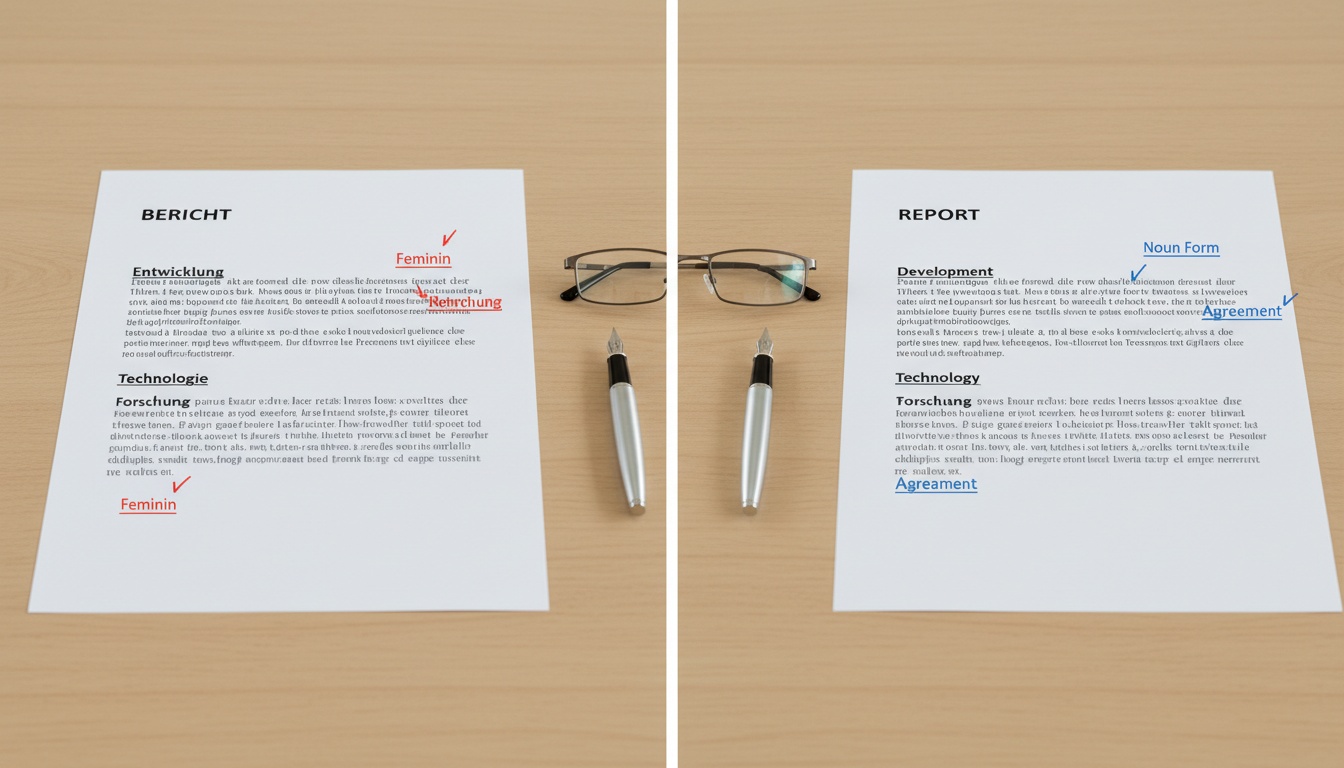
1. Why German-to-English Translation Trips Up Even Bilingual Speakers (And How to Avoid It)
German and English share Germanic roots but evolved into dramatically different systems. German preserves its complex case system (nominative, accusative, dative, genitive) while English abandoned most grammatical cases centuries ago.
Tap and speak in German
Tap to start
Word order creates immediate confusion. In contrast, German stacks verbs at sentence endings, especially in subordinate clauses. English speakers reading literal translations feel suspended, waiting endlessly for the action.
Compound word formation represents pure German efficiency. Germans create "Verschlimmbessern"—making something worse while trying to improve it. Unlike English, which lacks this mechanism, translators must choose between explanation, hyphenation, or equivalent phrases.
What Are the 3 Grammar Differences That Confuse Translators?
The German case system determines word relationships in ways English speakers find alien. Native speakers of English often struggle with these grammatical markers that disappeared from their language centuries ago.
Beyond cases, verb placement follows rigid rules that reverse English expectations. Dependent clauses push conjugated verbs to the end, creating suspense English simply won't tolerate.
Cultural expressions require complete reconstruction. "Ich verstehe nur Bahnhof" literally means "I only understand train station," but actually means "I don't understand anything." Direct translation destroys meaning entirely.
2. Which Translation Method Saves You Time vs Money vs Accuracy (And When to Use Each)
The translation landscape continues evolving rapidly. Modern neural networks handle context better than previous generations, though cultural nuance remains challenging.
AI Translation Tools vs Traditional Dictionaries
Multiple translation tools serve different purposes effectively. Speed matters for quick lookups, accuracy matters for important documents, and cultural context matters for meaningful communication.
A comprehensive German English dictionary like LEO provides pronunciation guides and real usage examples. When algorithms fail at idioms, traditional dictionaries supply the cultural context that makes translation meaningful.
Professional human translators dominate high-stakes content. Legal documents, medical records, marketing copy—anything where mistakes damage relationships or violate regulations requires human expertise.
Choose AI for Speed, Dictionaries for Context, Humans for Critical Work
Quick email translations or casual reading? AI handles routine communication effectively. Choose based on your accuracy requirements versus speed needs.
Vocabulary building or context checking? Dictionary resources win consistently. LEO shows pronunciation, while bilingual websites demonstrate real-world usage patterns.
Professional documents requiring precision? Human translators remain irreplaceable. The cost difference disappears when mistakes could damage business relationships or legal compliance.
3. When Should You Use Voice Translation Apps?
Real-time conversation translation presents unique challenges that written tools don't address. German pronunciation varies significantly by region—Bavarian German sounds completely different from Hamburg German. Voice translation apps struggle with background noise and regional accents.
I've watched business meetings derail when translation software couldn't distinguish between "Gift" (poison) and "gift" (present) in noisy environments.
Audio translation works best for single-direction listening. When only you need to understand German audio content, voice tools excel. Two-way conversations require different approaches entirely. Real-time voice translation tools handle live conversation better than traditional AI, though they still struggle with regional accents and background noise.
4. 5 Translation Mistakes That Cost Businesses Money (And How to Catch Them Before They Damage Client Relationships)
False cognates destroy more translations than any other single factor. "Gift" means poison in German, not present. "Aktuell" means current, not actual. Even bilingual speakers fall into these traps regularly.
Word order errors plague machine translations and human beginners alike. German's flexible sentence structure doesn't map to English patterns, especially in complex sentences with multiple clauses.
Grammar and Cultural Pitfalls
The German case system creates phantom errors in English. As a result, beginners try preserving German grammatical relationships that don't exist in English, producing awkward constructions that sound foreign.
Business emails suffer from German directness translated literally. "Sie müssen das sofort machen" becomes "You must do this immediately"—technically correct but culturally aggressive in English business contexts.

5. Real Examples of Translation Pitfalls
Technical documentation often preserves German compound words inappropriately. "Verschleißfestigkeit" isn't "wear-fastness" in English—it's "wear resistance" or "durability."
Academic papers frequently maintain German sentence length and complexity. English readers expect shorter, more direct sentences than German academic style permits.
Legal translations require understanding different legal systems entirely. "Rechtsfähigkeit" doesn't map directly to English common law concepts, requiring explanation rather than translation.
6. How to Choose Between Free Tools (Fast, Good for Learning) and Paid Tools (Accurate, Built for Business)
Translation software options range from free basic tools to professional-grade platforms costing hundreds monthly. English belongs to the West Germanic branch of languages, making some translation patterns predictable across tools.
Free vs Paid Translation Options
Free options include Google Translate with unlimited usage and camera translation features. The accuracy varies significantly with content complexity and cultural context.
LEO Dictionary provides free access to comprehensive entries with pronunciation guides. Langenscheidt's online dictionary offers various features to support language learning.
Professional translation software targets specific industries and workflows. These tools integrate with document management systems and provide quality assurance features that casual users don't require.
Which Tool Works Best for Students, Professionals, and Specialists?
Students and language learning enthusiasts should combine multiple free resources. Dictionary access plus AI translation covers most educational scenarios without monthly costs.
Business professionals need reliable accuracy for client communications. Budget considerations matter less when translation errors could damage professional relationships.
Technical translators require specialized terminology databases. Industry-specific dictionaries provide precision that general tools miss entirely.
Academic researchers benefit from comprehensive reference materials. Free access makes dictionary resources particularly valuable for budget-conscious students and researchers.
How to Translate Large Documents Efficiently
Document processing requires different approaches than single-sentence translation. Large files need consistent terminology and formatting preservation across hundreds of pages.
File format support varies between tools. For example, PDF translation often loses formatting, while Word documents maintain structure better through professional translation software.
Integration capabilities matter for business workflows. Translation tools that connect with content management systems save hours of manual copying and formatting.
7. German to English Translation for Specific Industries
Technical translation demands precision that general tools can't deliver. German engineering documents use compound words that don't exist in English—"Qualitätssicherungsmaßnahmen" requires explanation, not literal translation.
Medical, Legal, and Business Translation Challenges
Medical terminology follows international standards, but German medical culture includes concepts foreign to English-speaking healthcare. "Verschreibungspflichtig" implies different patient-medication relationships than simple "prescription-required."
Legal document translation requires certified translators in most jurisdictions. Court systems demand accuracy that only human expertise can guarantee.
Business correspondence walks a cultural tightrope. German business communication sounds blunt when translated literally—cultural adaptation matters more than linguistic precision.
What Resources Do Professional Translators Use?
Industry-specific dictionaries provide terminology that general tools miss. Medical translators rely on specialized resources for accurate terminology that could affect patient safety.
Professional translation services charge premium rates but deliver accuracy that automated tools can't match. Specialized knowledge justifies higher costs for critical content.
Document translation workflows typically combine machine translation for first drafts with human review for accuracy. This hybrid approach balances speed with reliability requirements.
8. How Has Translation Technology Evolved Since the 1950s?
German-English translation evolved through technological advances. Early efforts in machine translation began in the 1950s, notably with the Georgetown-IBM experiment in 1954, but meaningful progress required decades of linguistic research and computational power.
The widespread democratization of translation access through online tools largely occurred in the 2000s, making translation resources available to millions of users worldwide.
Neural machine translation, introduced in 2016, has evolved dramatically. Modern AI systems understand context in ways rule-based systems never could, achieving near-human accuracy on common language pairs, though German-English still presents challenges with compound words and regional dialects.
9. How Can You Improve Your Translation Skills Without Formal Training?
Practice with parallel texts—books available in both German and English. Compare professional translations with your attempts to understand decision-making patterns that experienced translators use.
Building Vocabulary and Cultural Understanding
Build vocabulary systematically by focusing on frequency rather than random words. High-frequency vocabulary appears in most texts, making it your translation foundation.
Understanding cultural context matters more than perfect grammar. Germans communicate differently than English speakers—directness versus politeness, formality versus casualness, precision versus flexibility.
Actually, here's something most guides won't tell you: excellent German to English translators often translate poorly from English to German. Translation isn't bidirectional—it requires deep cultural understanding of the target language, not just the source.
Linguistic differences between German and English extend beyond grammar into cultural communication patterns. What sounds polite in German might seem cold in English, and what sounds friendly in English might seem unprofessional in German.
10. Your Action Plan: Which Translation Method to Use for Your Specific Needs
- Multiple AI solutions offer different strengths for German to English translation, with varying accuracy levels depending on content type and cultural context
- Dictionary resources excel at providing context and real usage examples that automated tools often miss
- Professional human translation remains essential for legal, medical, and business documents where accuracy affects outcomes
- False cognates and cultural expressions cause more translation errors than pure grammar differences
- Combining multiple tools—AI for speed, dictionaries for context, humans for critical content—delivers optimal results
- Industry-specific translation requires specialized knowledge and often certified professional translators
- Historical technological advances continue shaping translation accuracy and accessibility